THE GENIUS OF LUTHERANISM MAY be our clear teaching of justification by grace through faith in Christ alone. But the joy of Lutheranism is our hymns! This year, as part of the 500th anniversary of the Reformation celebrations, we remember the first Lutheran hymnals, published in 1524.
Hymn-singing has been part of God’s worship since the Old Testament. The book of Psalms is a hymnal within the Bible. The Psalms were used in Temple and Synagogue services, and naturally remained a part of early Christian worship. St. Paul called for Christians to ‘be filled up in the Spirit, speaking to each other in psalms and hymns and songs of the Spirit’ (Eph. 5:18-1).
These ‘hymns and songs’ may have included biblical canticles, such as we find in Luke 1–2 and sing in Matins and Vespers. But most likely the early Christians also expressed their faith in hymns of their own making.
Hymnody flourished for centuries, particularly in monasteries; however, sadly, there was little congregational hymn-singing in the chief Sunday service by the high Middle Ages.
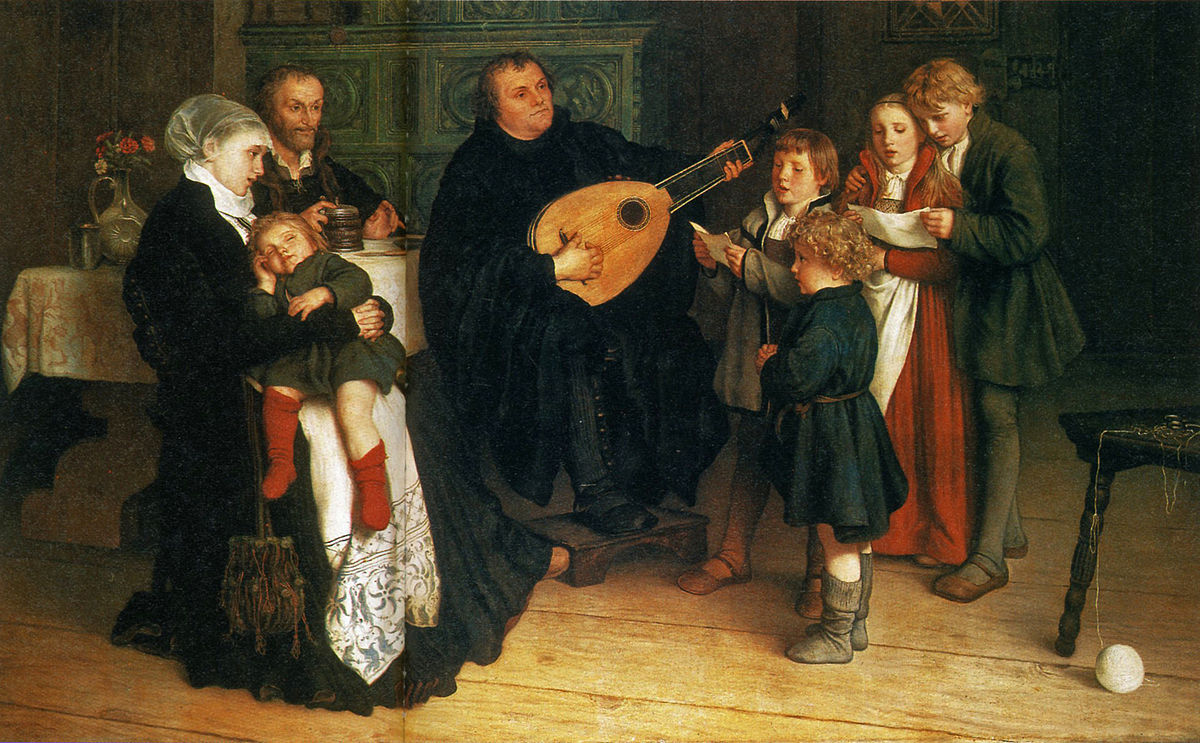
Early Lutherans saw an opportunity to spread the Gospel by reviving congregational song. Luther seems to have got the idea from the popular practice of news ballads. Singers would put the news into rhyme and sing it to the people in town squares and inns, then print up the song on a broadsheet to post in public.
In 1523 Luther imitated them by writing a sober tribute to two followers who had been martyred in Brussels. His ballad, ‘A New Song We
Now Begin’, wasn’t really a hymn, but it sparked the brilliant idea of spreading the Gospel through song. In the preface to an early hymnal he wrote, “I … have with the help of others compiled several hymns, so that the holy Gospel which now by the grace of God has risen anew may be set forth and given free course” (Luther’s Works 53:316).
In the years 1523–26 Luther threw all his energy into reforming worship. In his revision of the Latin mass (1523) he called for vernacular songs for the people to sing between the Epistle and Gospel (the Hymn of the Day) and during Communion distribution. He encouraged poets and musicians to find a unique German way to match words to music. Luther accepted his own challenge and wrote 24 of his lifetime output of 36 hymns in just one year!
In his German Mass (1526) he added the idea of singing the major texts of the liturgy in hymn paraphrases (e.g. his creed hymn, ‘We All
Believe in One True God’, LSB 954). But we’re getting ahead of the story.
In January 1524 an enterprising printer gathered together eight hymns that had been recently printed on broadsheet and published the first Lutheran hymnal. Known popularly as the Achtliederbuch (‘Eight Hymn Book’), it contained four hymns by Luther, three by his colleague Paul
Speratus, and one anonymous. Remarkably, three of these hymns are still in use:
• ‘Dear Christians, One and All, Rejoice’ (LSB 556)
• ‘Salvation Unto Us Has Come’ (LSB 555)’
• ‘From Depths of Woe I Cry to Thee’ (LSB 607)
The first two tell the epic tale of our salvation, from the tragedy and helplessness of our sinful condition to God’s sending forth His Son in the flesh to redeem us. They teach the distinction between Law and Gospel, and are spectacular illustrations of how the reformers sang the pure Gospel into people’s hearts.
The third hymn is Luther’s paraphrase of Psalm 130. Putting the Psalms into rhyming verse was a Lutheran innovation that would come to be copied by the Calvinists and lies at the heart of Anglican hymnody. What was unique about the Lutheran approach was how they wove the Psalm’s deeper Christological meaning into the paraphrase.
Getting even a tiny booklet of hymns into the hands of the people was revolutionary. But the larger collections published later that year
more deservedly bear the title of ‘hymnal’. The Erfurt Enchiridion introduced among its 25 hymns the Advent favourite, ‘Saviour of the Nations Come’ (LSB, 332), the Communion hymn ‘O Lord, We Praise Thee’ (LSB 617), and Luther’s translation of the mediaeval Pentecost hymn, ‘Come, Holy Ghost, God and Lord’ (LSB 497). A Wittenberg hymnal that year included 32 hymns, with a companion choir book containing four-part choral settings. An explosion of hymn writing had been sparked.
The titles of many early Lutheran hymnals emphasised the twin themes of ‘teaching’ and ‘comfort’. Hymns were part of the overall programme
of reforming the church through God’s Word. Lutheran hymns could be strongly doctrinal, but they also served the liturgy by letting the people sing parts that previously were sung only by choirs made up of clergy (or school-boys). Hymns were deliberately written for each season of the church year and arranged that way in the hymnals.
Countless Psalm paraphrases gave voice to Christian piety and faith by bringing the ancient texts into contemporary Christian lives—‘A Mighty Fortress’ (LSB 656), which turned Psalm 46 into a battle cry against their devilish foes, is the most famous example. Perhaps hymns were part of the Reformation’s genius, too!